The Project Tags

Nonprofit/B2C

Nonprofit/B2C

Health & Wellness

Mobile App

Online Therapy

Mindfulness Tool

Mobile App

Context

During my first Google hackathon, students were challenged to identify a meaningful real-world problem and build a working technical solution for it in under 24 hours. Because the challenge was open-ended, my team and I spent time exploring issues that were becoming increasingly visible among our peers. Rising levels of stress, anxiety, social disconnection, and suicide among young people drove our focus toward mental health. This led us to explore how technology could play a role in making mental health support more accessible and personal.

Problem

Mental health challenges among young people are rising, yet access to meaningful support remains difficult. There is still a stigma around mental health that keeps many from asking for help in the first place, and even when they do, they often don’t get to talk to someone who understands their background and can relate to their lives. Many mental health solutions only solve one part of the problem, forcing young people to rely on multiple sources for support. That makes an already difficult issue feel even more fragmented and harder to navigate.

The next generation needs mental health support that is easier to access, understand, and built around them.

The next generation needs mental health support that is easier to access, understand, and built around them.

leading cause of death for people age 15-24 is suicide (2018)

leading cause of death for people age 15-24 is suicide (2018)

2nd

2nd

of lifetime mental health conditions begin before

age 24

of lifetime mental health conditions begin before

age 24

75%

75%

adults in the U.S. experience mental illness each year

adults in the U.S. experience mental illness each year

1/5

1/5

of young people with major depression do not receive treatment 

of young people with major depression do not receive treatment 

60%

60%

The Process

Because the challenge was open-ended, the canvas for what problem we could build for was wide open. We spent the first few hours looking at major issues and reflecting on what was directly impacting us as college students. That led us to look inward at problems where our own experiences could give us a different perspective. When we came across data showing suicide was the second leading cause of death among young people, it became clear that mental health was a problem worth digging into more deeply.

Our team went heads down researching problems worth solving and generated over 50 possible problems to tackle on a sticky board. I helped lead the effort to narrow them down by asking which ones felt most present in our own lives, then pressure-testing the remaining ideas based on how painful the problem really was. Once we uncovered the statistic that suicide had become the second leading cause of death among our age group, it became clear which problem we needed to focus on.

Our team went heads down researching problems worth solving and generated over 50 possible problems to tackle on a sticky board. I helped lead the effort to narrow them down by asking which ones felt most present in our own lives, then pressure-testing the remaining ideas based on how painful the problem really was. Once we uncovered the statistic that suicide had become the second leading cause of death among our age group, it became clear which problem we needed to focus on.

First Step

First Step

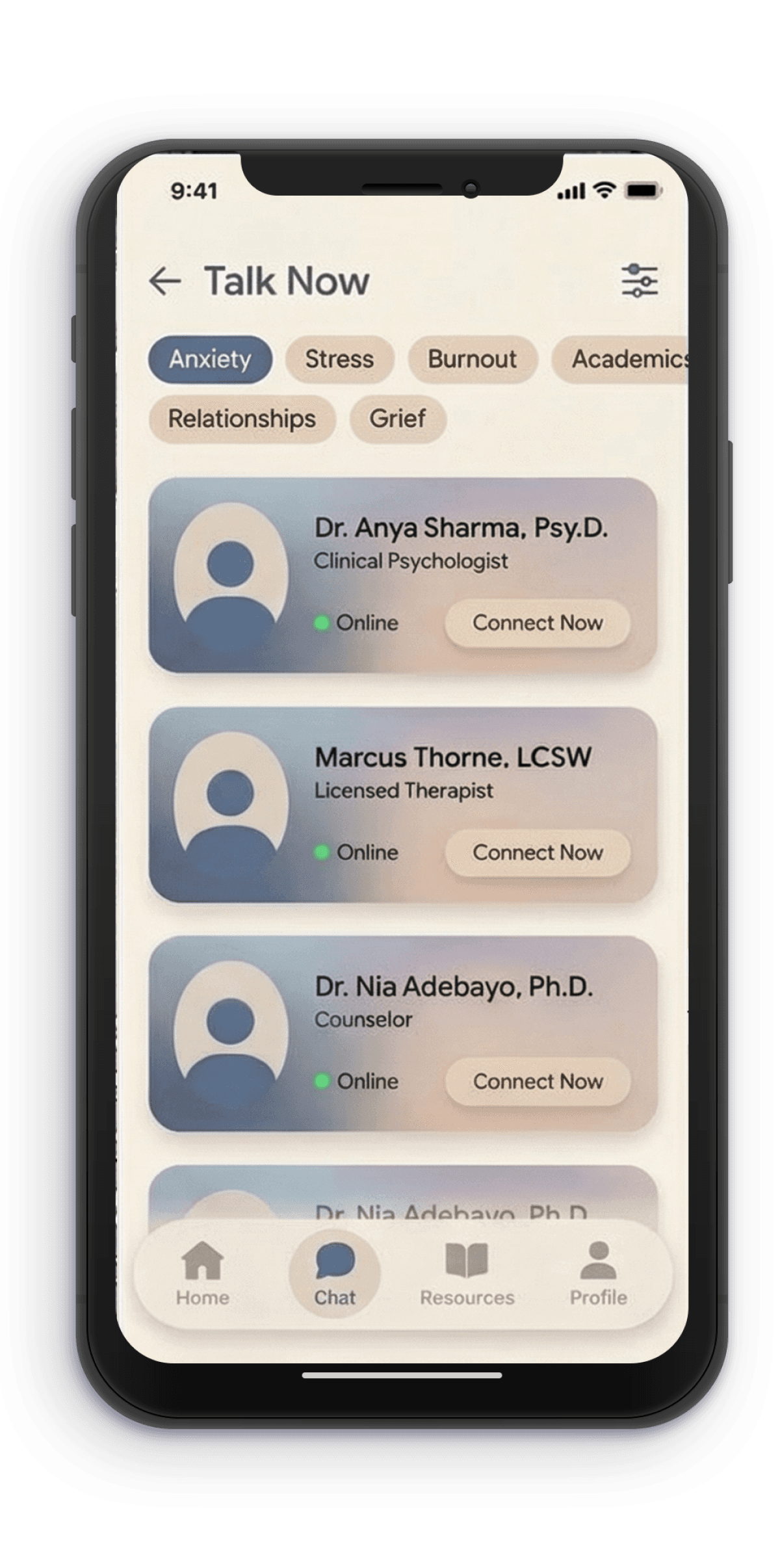
We put together a Google Form and got around 20 student responses on how they deal with stress and seek help today. A lot of what came back pointed to the pressure of managing school, work, and life on your own, with the alarm clock often being the thing that starts a stressful day. We also learned that several respondents, especially Black students, would only get therapy from someone they felt could better relate to their background and experiences. 

We put together a Google Form and got around 20 student responses on how they deal with stress and seek help today. A lot of what came back pointed to the pressure of managing school, work, and life on your own, with the alarm clock often being the thing that starts a stressful day. We also learned that several respondents, especially Black students, would only get therapy from someone they felt could better relate to their background and experiences. 

Getting Real Data

Getting Real Data

This is where we aligned on which pain points our solution needed to address and started exploring ways to solve them. We filled another board with potential ideas and features, originally trying to narrow everything down to a single solution. But after a few good debates with the team, we realized some of the strongest ideas made more sense together than as separate solutions. That’s when the concept of a single app addressing multiple aspects of mental health support really came about, including the stress-free alarm feature that came directly from our research insights.

This is where we aligned on which pain points our solution needed to address and started exploring ways to solve them. We filled another board with potential ideas and features, originally trying to narrow everything down to a single solution. But after a few good debates with the team, we realized some of the strongest ideas made more sense together than as separate solutions. That’s when the concept of a single app addressing multiple aspects of mental health support really came about, including the stress-free alarm feature that came directly from our research insights.

Addressing Pain Points

Addressing Pain Points

Once we felt confident in the solution, we moved straight into wireframing the core screens and flows we wanted the app to include. Even though our team had one main engineer, all of us pitched in and learned enough Swift to help bring the product to life and get it working on iPhone. We spent the rest of the night moving between wireframes and the codebase until we had a functional prototype ready by morning. 

Once we felt confident in the solution, we moved straight into wireframing the core screens and flows we wanted the app to include. Even though our team had one main engineer, all of us pitched in and learned enough Swift to help bring the product to life and get it working on iPhone. We spent the rest of the night moving between wireframes and the codebase until we had a functional prototype ready by morning. 

Making MVPs

Making MVPs

The final night was spent pulling together our research insights, product features, prototype, and overall narrative into something we could present clearly the next morning. It was important to me that we not only show what we built, but also explain the value behind it, how it addressed the problem, and what success would look like if it worked. I took the lead on shaping a story that made sure our solution was communicated in a way that felt clear, focused, and worth believing in. 

The final night was spent pulling together our research insights, product features, prototype, and overall narrative into something we could present clearly the next morning. It was important to me that we not only show what we built, but also explain the value behind it, how it addressed the problem, and what success would look like if it worked. I took the lead on shaping a story that made sure our solution was communicated in a way that felt clear, focused, and worth believing in. 

Iterating & Refining Final Product

Iterating & Refining Final Product

The Solution

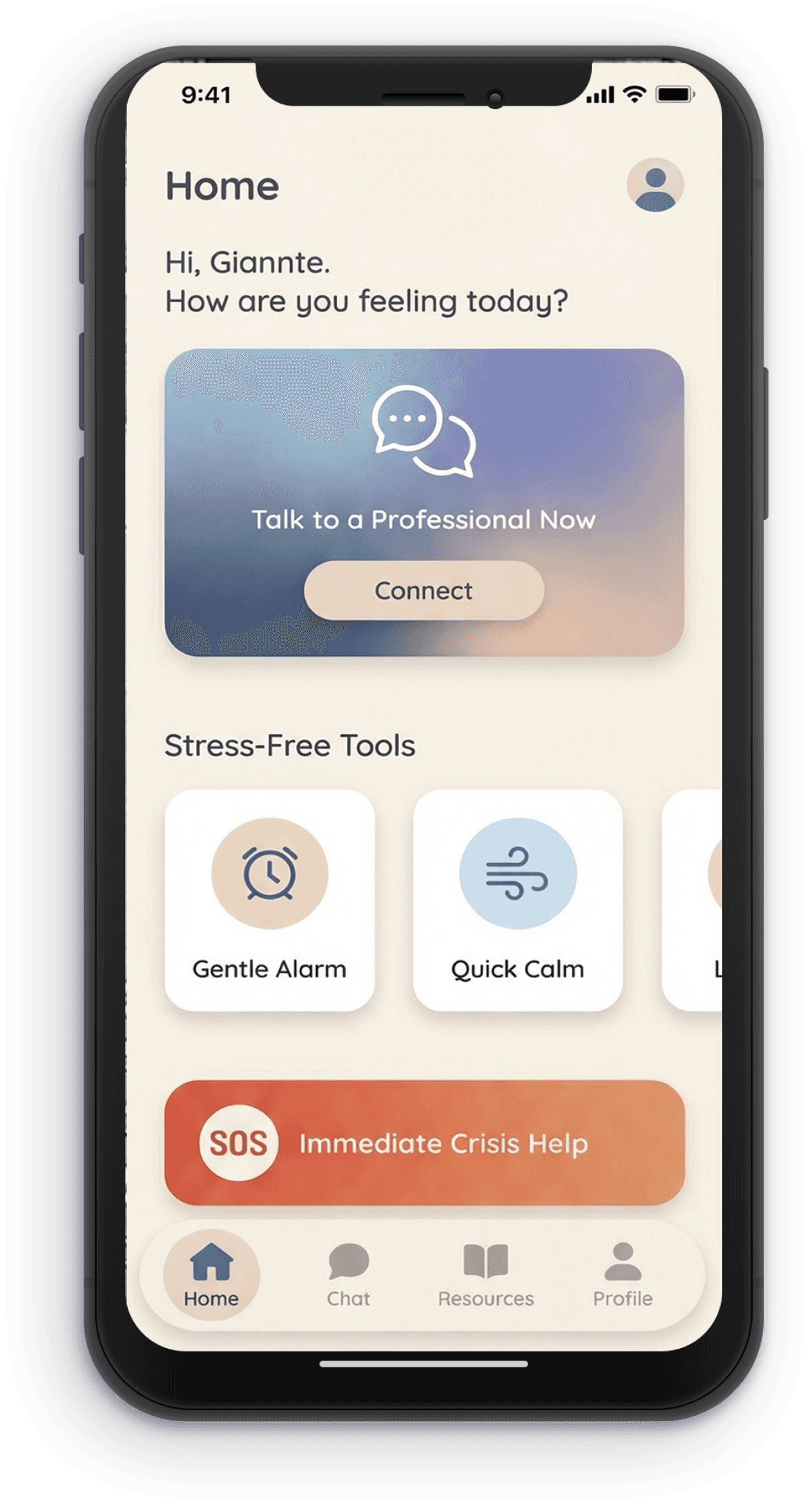
Mobile Therapy is an app designed to support users at different points in their mental health journey. The experience combined a stress-free alarm to ease anxiety around daily routines, a personalized network of mental health professionals matched to the user’s background and needs, and a quick-access help line for moments when someone needed immediate assistance.
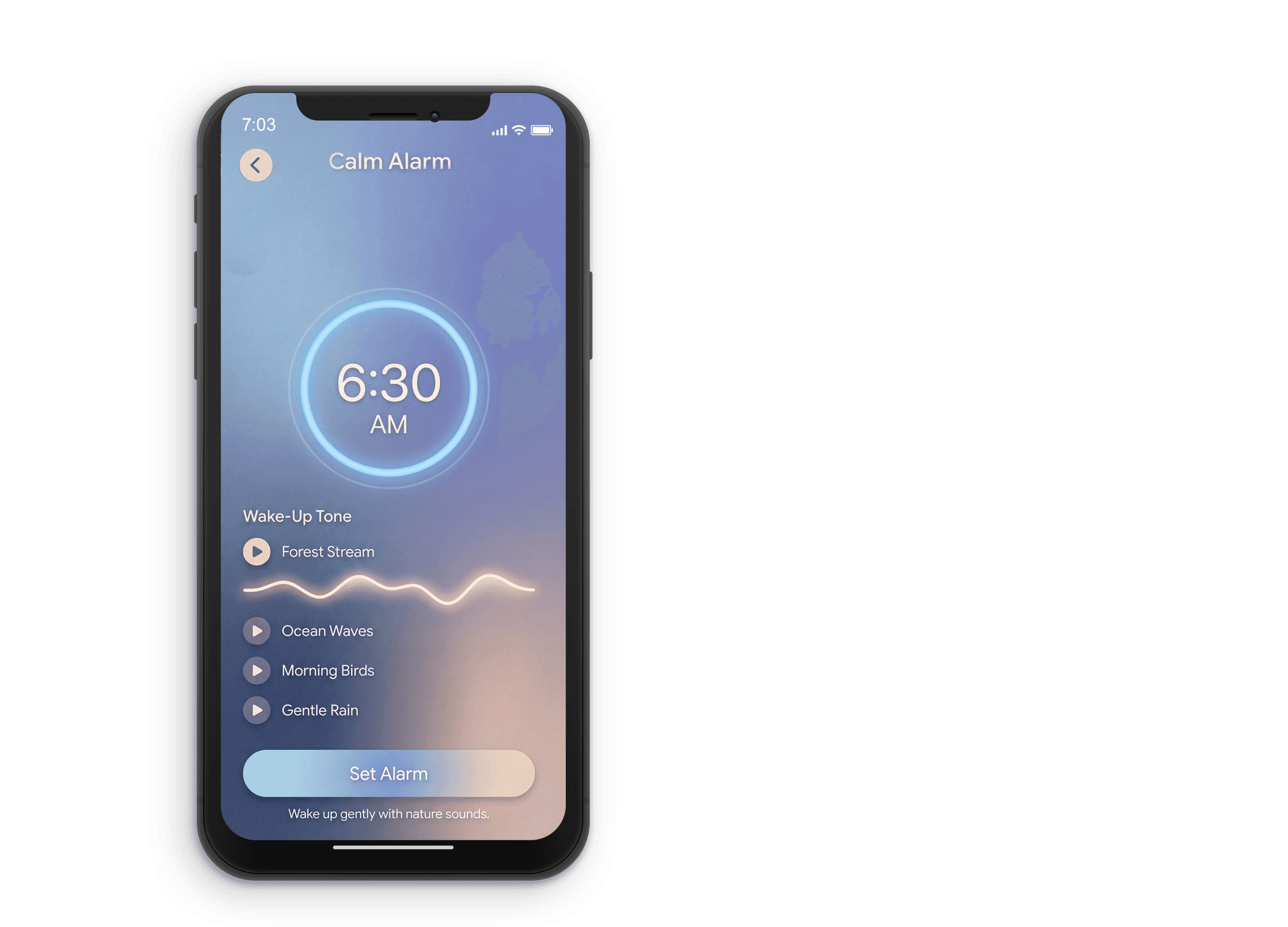
Many of the students we surveyed described the morning alarm as the moment their stressful day began. To address this, we designed a stress-free alarm that replaces jarring alarm sounds with more calming cues intended to help users start their day with greater focus and less anxiety.

Many of the students we surveyed described the morning alarm as the moment their stressful day began. To address this, we designed a stress-free alarm that replaces jarring alarm sounds with more calming cues intended to help users start their day with greater focus and less anxiety.

Stress-free alarm

Stress-free alarm

Many of the students we surveyed described the morning alarm as the moment their stressful day began. To address this, we designed a stress-free alarm that replaces jarring alarm sounds with more calming cues intended to help users start their day with greater focus and less anxiety.

Many of the students we surveyed described the morning alarm as the moment their stressful day began. To address this, we designed a stress-free alarm that replaces jarring alarm sounds with more calming cues intended to help users start their day with greater focus and less anxiety.

Immediate Crisis Help

Immediate Crisis Help

Many of the students we surveyed described the morning alarm as the moment their stressful day began. To address this, we designed a stress-free alarm that replaces jarring alarm sounds with more calming cues intended to help users start their day with greater focus and less anxiety.

Many of the students we surveyed described the morning alarm as the moment their stressful day began. To address this, we designed a stress-free alarm that replaces jarring alarm sounds with more calming cues intended to help users start their day with greater focus and less anxiety.

Personalized Therapy

Personalized Therapy

of users who engage with preventative support (alarm or therapist) without escalating to emergency help

of users who engage with preventative support (alarm or therapist) without escalating to emergency help

%

%

of therapists connections that result in a second session

of therapists connections that result in a second session

%

%

of stress-free alarms triggered per user per week

of stress-free alarms triggered per user per week

#

#

of successful emergency connections

of successful emergency connections

#

#

Average snooze

count per alarm trigger

Average snooze

count per alarm trigger

<=1

<=1

Guardrail Metric

Guardrail Metric

Success Metrics

Success Metrics